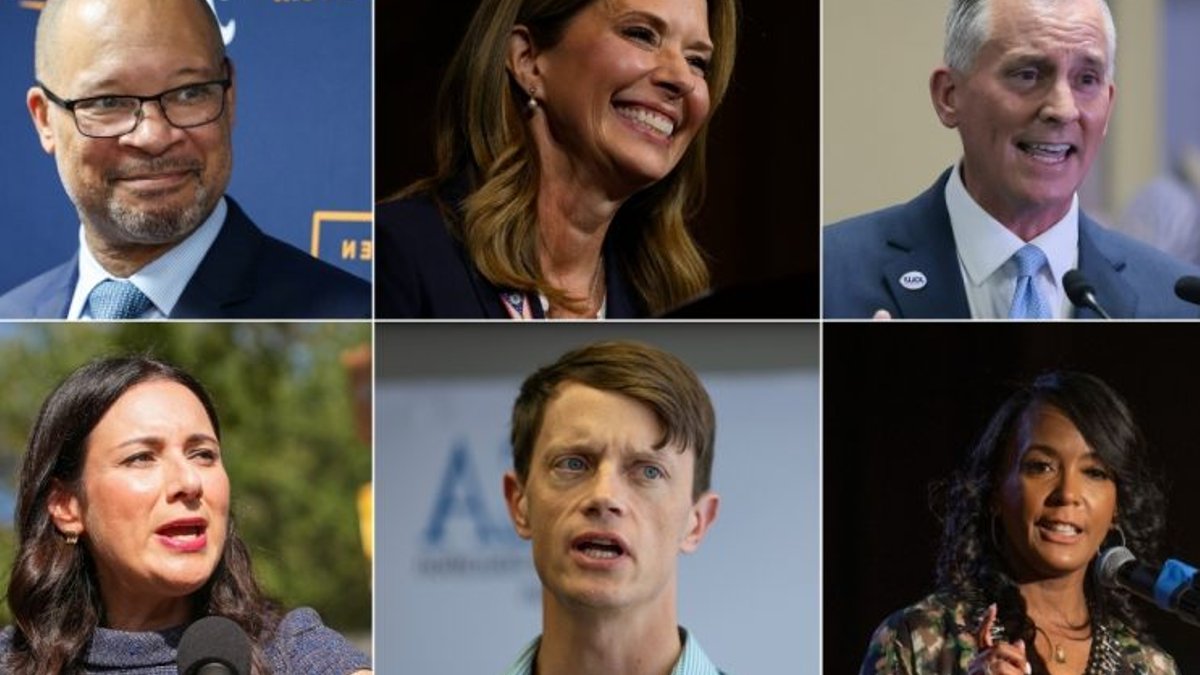
With less than a week before the November ballot, analysts say a wave of Democratic victories could give the party control of more than half the nation’s governorships, a shift not seen since the early Obama years. That change would move education policymaking from a largely Republican-led state arena to a more balanced playing field.
Democratic Gains Could Reshape State Education
Federal education policy in the second Trump administration has been a strictly one-sided negotiation, with Republicans unilaterally prising authority from the U.S. Department of Education, pushing through a new school choice benefit, and significantly altering the enforcement of civil rights laws like Title IX. By contrast, state governments fund and run most K-12 schools, giving governors considerable agenda-setting power.
Forecasters such as the Cook Political Report and the University of Virginia’s Center for Politics list five states where Democratic candidates have at least even odds of flipping the governor’s office: Alaska, Georgia, Iowa, Nevada and Ohio, together home to roughly 4.4 million K–12 students. Polls also show the party within striking distance in Texas and Florida, the two largest education markets.
“There’s a pretty wide gap right now between what Democrats and Republicans want for K–12 education, especially when it comes to school choice policies and how we fund public schools,” said Jon Valant of the Brookings Institution’s Brown Center on Education Policy.
Related Post: Ohio Spends Over $1 Billion on Private School Vouchers
Michael Hartney, a political scientist at Boston College, believes that new leaders may struggle to identify a productive way forward for schools still fighting through a post-COVID morass of low achievement and high costs.
Key Races Highlight Policy Stakes
In Alaska, former state representative Jonathan Kreiss-Tompkins leads a three-candidate field under a ranked-choice system. A coalition of moderate Republicans, Democrats and independents in the Juneau legislature has repeatedly clashed with incumbent Republican Gov. Mike Dunleavy over school funding. Last summer, lawmakers initiated a rare veto override to increase total K-12 expenditures. Because of its unusual status as a petroleum exporter, Alaska’s finances are closely tied to oil prices, which have risen this year. But its academic needs are great, with recent math and reading scores scraping the bottom of national rankings. Fiscal pressures and declining enrollment forced the closure of 12 elementary and middle schools this year.
In Iowa, Democrat Rob Sand, a two-term state auditor, faces a deeply conservative legislature. He has pledged to tighten oversight of the state’s Education Savings Account program, a move that could set a precedent for other red-leaning states with voucher-like schemes.
Ohio’s race pits former health commissioner Amy Acton against a businessman. Acton wants to fully fund the Fair School Funding Plan, a formula designed to reduce reliance on local property taxes. The legislature underfunded public schools by roughly $2.75 billion compared with the plan’s calculations. Voucher programs continue to channel about $1.2 billion through five state scholarship schemes. A recent appellate court ruling declared the EdChoice scholarship unconstitutional, though enforcement is stayed pending appeal.
Related Post: Texas Senate race pits faith in schools against secularism
Georgia’s contest features former Atlanta mayor Keisha Lance Bottoms and Republican Rick Jackson. Bottoms proposes raising the starting teacher salary to $60,000 and funding the initiative through a casino-gaming amendment and a revamp of the Quality Basic Education formula.
In Nevada, polls show a razor-thin gap between incumbent Gov. Joe Lombardo and Democratic Attorney General Aaron Ford. Lombardo’s first term saw a $2.6 billion increase in K-12 funding—about $2,500 per student—paired with new testing and accountability measures.
Legislative Limits and Potential Policy Shifts If Democrats Gain Governorships
In Alaska, officials note that adequate funding and a better funding structure are essential to improve schools, though funding alone will not solve all problems. In Iowa, the Republican-led legislature retains the votes needed to block Auditor Rob Sand’s pledge to increase state aid for public schools, despite Republicans having helped enact the Fair School Funding Plan five years ago. The revamped formula, designed to reduce reliance on local property taxes and raise spending over six years, was scaled back in the 2025 budget as costs rose, prompting a researcher to describe the action as lawmakers shirking their duty. Enforcement of a recent voucher ruling remains stayed while voucher supporters await a decision from the Republican-controlled state supreme court.
Georgia and Nevada stand out from the Democrats’ other targets for the simple reason that each has become quite a welcoming environment over the last few cycles. The party, which held only one of the states’ four combined Senate seats in 2017, now boasts all four. In tightly contested gubernatorial races, Democrat Keisha Lance Bottoms and Republican Rick Jackson share priorities on reading instruction, teacher pay, and early education if they succeed incumbent Governor Brian Kemp.
