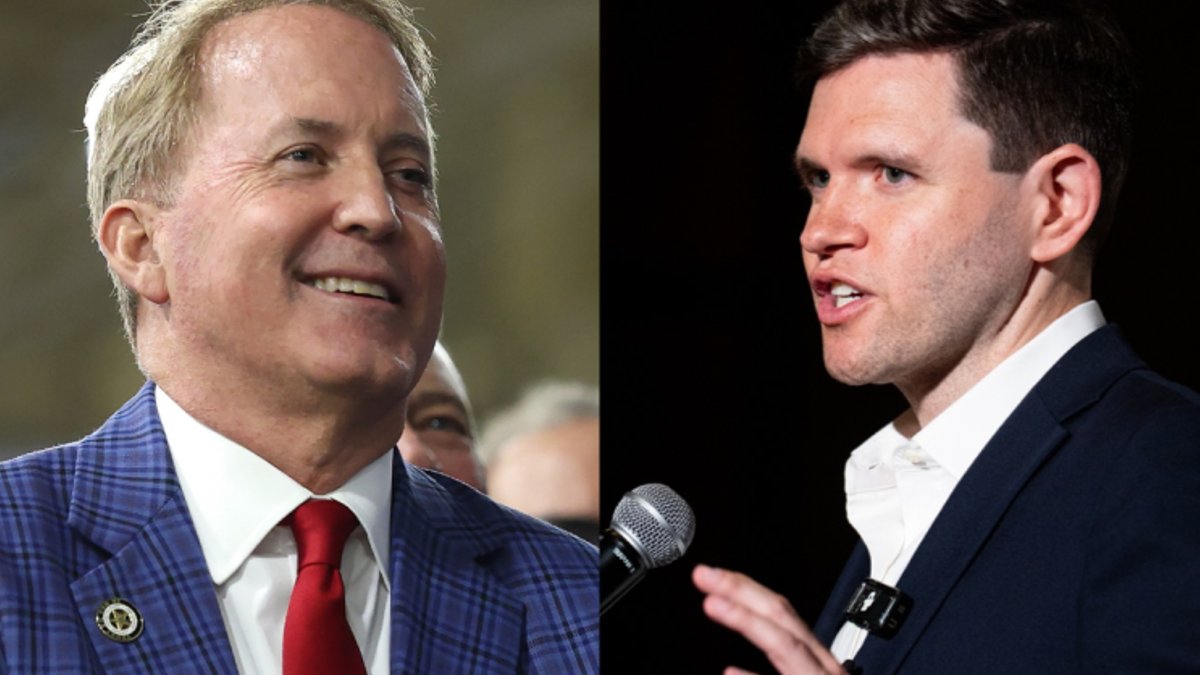
The 2026 U.S. Senate race in Texas has become a defining battle over how faith should shape public life, with the two leading candidates offering fundamentally different answers to the same question: What role should Christianity play in schools?
Republican attorney general Ken Paxton has built his political identity around his Christian faith, framing it as the bedrock of both his personal life and his approach to governance. “My Christian faith is the foundation to my life and public service,” Paxton, a Republican, said in a recent interview with a Christian magazine. This belief now extends directly into Texas classrooms.
Paxton’s office has played a leading role in enforcing the state law that requires schools to hang the King James Version of the commandments in every classroom, and he recommended the Lord’s Prayer from the Book of Matthew for daily prayer. The state’s 2023 legislation mandates that the King James Version of the commandments be posted in classrooms, and Paxton’s office has since launched compliance investigations into nearly 30 school districts.
This push reflects a broader Republican strategy in Texas, where biblical references are increasingly woven into public education standards. Last year, the state board of education approved a reading curriculum that incorporates Jesus’ life and parables, while social studies standards now emphasize Christianity more prominently than other religious traditions. Paxton issued an opinion last year that it was acceptable to integrate “religious literature” into multiple subjects, not just within a standalone course.
Democratic challenger rejects faith in state classrooms
His Democratic opponent, James Talarico, a former middle school English teacher and graduate of theological studies programs, rejects this vision outright. “I don’t want politicians and bureaucrats teaching my faith,” he said last year in a PBS interview, as some districts began adopting a state-approved reading curriculum that includes the life of Jesus, the parables he taught and other biblical material. “I want pastors and Sunday School teachers to be teaching my faith.” Talarico, who has taught in public schools, has criticized the state’s efforts to embed biblical content in classrooms, arguing such moves blur the constitutional boundary between church and state.
He questioned why the newly adopted Bluebonnet reading curriculum excluded references to Islam’s Prophet Muhammad, despite the faith being practiced by approximately half a million Texans. During a committee hearing, he challenged state education officials on how teachers would respond to elementary students asking about the biblical resurrection—a concept now included in the curriculum.
Related Post: New Book Transforms Grammar Teaching for Middle School Students
The policy differences between the two candidates have direct consequences. Paxton’s legal opinions have shaped Texas education policy, including his 2023 ruling that voucher programs for private schools do not violate constitutional separation principles. This year, he expanded that stance by allowing the state comptroller to exclude schools from the education savings account program if they had ties to the Council on American-Islamic Relations or the Chinese government. That decision triggered lawsuits from Islamic schools, which were later reinstated. Talarico considers vouchers a “scam” and an effort to “dismantle public education”. His amendment calling for a referendum didn’t pass, and lawmakers ultimately approved the voucher bill.
Poll shows tight race over religion’s public role
A CBS poll currently shows Talarico leading Paxton by just two percentage points, with party loyalty driving the race. Paxton’s base consists of Trump-backed conservatives, while Talarico appeals to Democrats concerned about the state’s push to integrate religious material into public schools. Even within the Republican Party, dissenters like Glenn Rogers, a former state representative, question Paxton’s approach. “Can you show me one single child that has been brought to Christ because the 10 Commandments were posted on the wall?” he asked, illustrating the divide over whether public institutions should acknowledge religion—or actively promote it.
The debate now centers on two competing interpretations of Christianity’s role in public life. Paxton advocates for a model where Protestant values are embedded in state governance, including education. His legal opinions frame religious freedom as a defense against what he calls secular influences in schools. For example, his 2023 voucher ruling argued that public funding of private religious schools aligns with the First Amendment’s protection of religious exercise. Critics argue this creates an implicit hierarchy favoring Christian perspectives over other faith traditions or secular viewpoints.
Talarico’s vision: Pluralism over Christian dominance
Talarico, however, rejects the idea that public policy should be shaped by any single religious doctrine. His theological background and teaching experience inform a stance that prioritizes separation of church and state as a safeguard for pluralism. His objection to the Bluebonnet curriculum’s omission of Islam’s Prophet Muhammad, given the faith’s half-million adherents in Texas, reflects a broader principle: public education must engage with all major worldviews, not just those aligned with a dominant political or religious faction.
The candidates also clash over how faith should influence economic and social policy. Paxton quotes scripture to emphasize religious liberty, moral order and traditional social values. Talarico, by contrast, ties his policy views to a different interpretation of Christian ethics-one rooted in social justice. He has repeatedly cited Jesus’ teachings on caring for the poor, arguing that Texas’ cuts to Medicaid and food assistance programs violate core ethical principles. His support for expanded healthcare access, even for undocumented immigrants, stems from his belief that “loving thy neighbor” requires universal care regardless of legal status.
