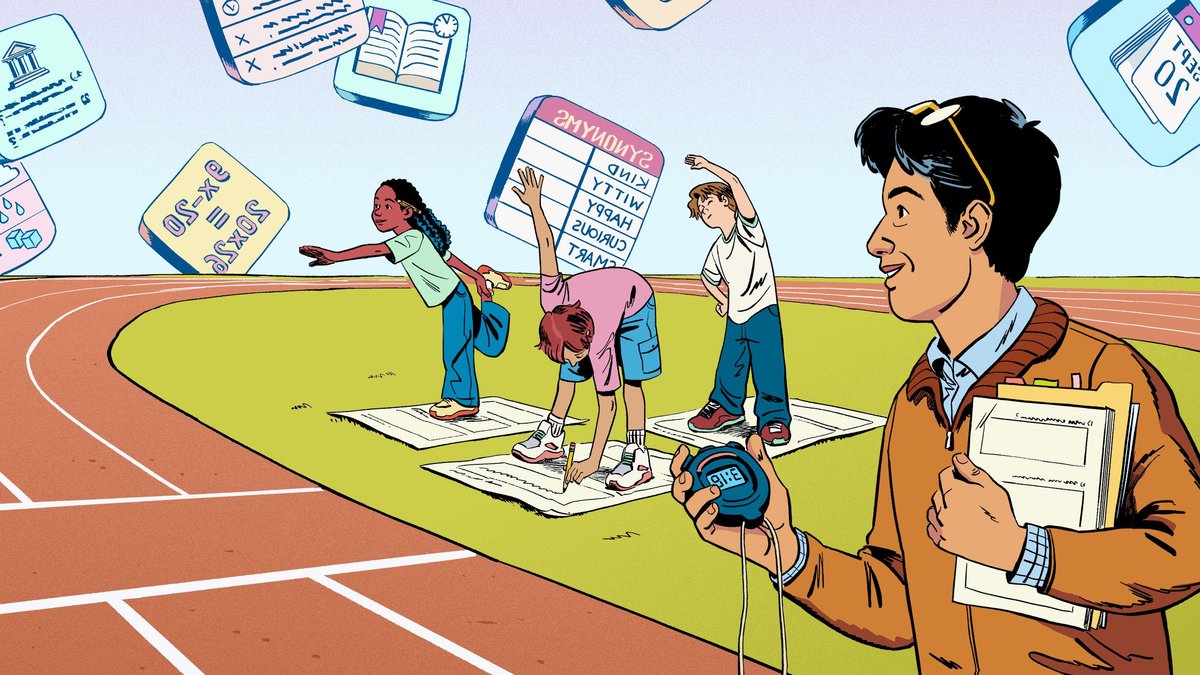
Every classroom has a moment between the bell and the lesson: students still chatting, backpacks unzipped, minds lingering on the previous period. That gap doesn’t need to be wasted time. Teachers across subjects and grade levels use bell ringers—short, structured activities—to refocus attention, activate prior knowledge, and prepare students for discussion. The most effective ones do more than occupy minutes; they create readiness for engagement.
Nearly 400 educators shared their most effective bell ringers after a widely shared request, offering ideas adaptable to math, science, history, and English. Some rely on quick questions, while others use visuals or collaborative tasks. The key is consistency: an activity that works repeatedly, whether it’s identifying errors in a math problem or debating ethical dilemmas connected to the day’s lesson.
Activities That Work Across Subjects
Earth science teacher Emily May uses Which One Doesn’t Belong? by giving students four terms, such as evaporation, condensation, sublimation, and freezing, and asking which doesn’t fit. The absence of a single correct answer forces students to weigh relationships between concepts.
My Favorite No turns mistakes into learning opportunities. Students solve a math problem anonymously, and the teacher selects a wrong answer to analyze as a class. The focus shifts from blame to strategy: why did the error occur, and how can it be corrected? Middle school math teacher Nick Rhoades observes that students often recognize their own mistakes during discussions.
Flash Philosophy immerses high schoolers in ethical debates mid-lesson. Teacher Benjamin Barbour poses questions like “Should we follow laws we believe are morally wrong?” Students write brief responses before pairing up. This reveals how quickly students can apply abstract ideas to real-world scenarios, and how much they learn from each other’s perspectives.
Social-Emotional Learning Through Pair Discussions
Some activities prioritize social or emotional learning. Inside-Outside Circle, created by instructional specialist Christopher Tobin, pairs students facing each other to discuss a prompt, then rotates one circle to mix conversations. The rule requires each exchange to end with an acknowledgment of what was appreciated in the other’s perspective.
Not every strategy requires movement or discussion. Mindful Journaling, used by elementary teacher Donna Paul, gives students quiet time to reflect with prompts like “One thing I’m noticing this morning…” The goal is presence, helping students transition from hallway chatter to focused work.
Other activities blend creativity with academic rigor. A well-chosen bell ringer, like an error to hunt for in a worked problem, or a question about who deserves the most blame in Romeo and Juliet, or a historical photograph packed with details to investigate, can help students settle in and give them something engaging to quickly turn their attention to.
How Purposeful Bell Ringers Boost Engagement
Effective bell ringers share two key traits: they are brief enough to maintain attention without overwhelming it, and they connect to what follows. A math teacher might use Mystery Number, where clues lead to a hidden answer, while a civics teacher embeds errors in government-branches questions to spark debate. The difference between a filler task and a true bell ringer lies in its purpose.
In classrooms where time is limited, these activities demonstrate that even the first few minutes can shape the rest of the period. The challenge isn’t finding ideas; it’s selecting the right one for the day’s lesson. Some teachers rotate through a few options, while others stick with what works best for their students. What matters most is that the bell signals the start of learning.
High school civics teacher Eiza Aurangzaib embeds errors into government-branches questions to provoke discussion. For example, she might present a statement like “The executive branch makes laws” and ask students to identify the mistake. The activity forces them to recall roles of government branches while justifying corrections.
Visual and Creative Hooks for Focused Learning
Quick Sorts transforms vocabulary into an active task. Social studies teacher Jess Quiggle hands out cards with terms like “high birth rate” or “negative population growth” and asks students to categorize them under stages of the demographic transition model. The hands-on sorting helps them visualize relationships between concepts.
