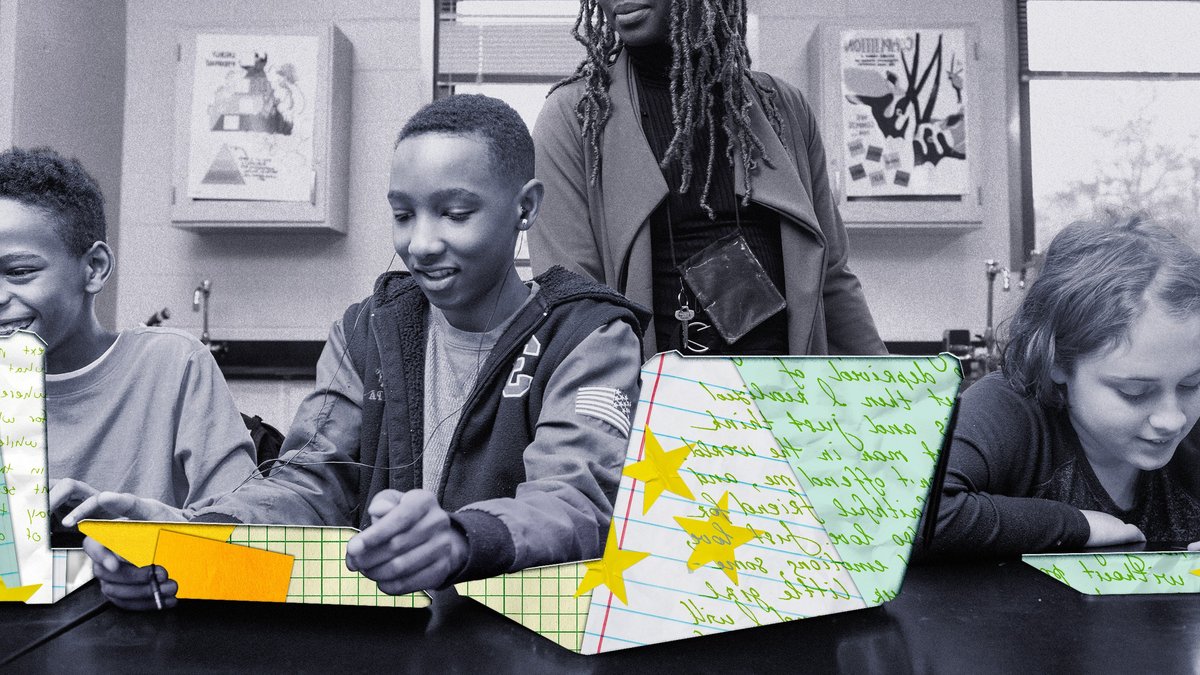
Frustrated by students’ digital distractions, high school chemistry teacher Marcie Samayoa reduced Chromebook use in her classroom, opting for paper-based activities instead. She told EducationWeek, “I had to reformat everything,” but the results were worth it. By switching note-taking, vocabulary, and review exercises to paper and mini-whiteboards, Samayoa noticed a significant improvement in student focus and found herself with more energy to dedicate to teaching.
Samayoa is part of a growing number of teachers reconsidering how and when digital tools and devices should be used in the classroom, especially as concerns mount about AI’s effects on critical thinking and creativity. They are not abandoning technology, but looking for more intentional ways to slow down student thinking, inspire reflection and collaboration, and sustain attention.
Revisiting Traditional Tools
Educators are increasingly turning to traditional tools like notebooks, journals, and sticky notes to support more immersive learning across disciplines. For instance, English instructor Dana Haring and history teacher Tom Kelner assign students to maintain a dedicated notebook profiling influential literary and historical figures, such as Frederick Douglass or Mary Shelley, to deepen their research and contextual understanding.
Dana Smith, a middle school English teacher, simplifies character analysis by having students jot down questions on sticky notes after reading a chapter from The Giver. This low-pressure method encourages participation without overwhelming them, and the brief discussions that follow help students explore characters in greater depth.
High school English teacher Christina Torres Cawdery brings her students outside to write in nature journals, using activities like “Same Spot, Different Story” and “Mood Swap” to help them observe closely and practice sensory writing. Students might describe an outdoor location as if they love it, and then again as if they hate it, or move to different locations and describe each spot through the lens of an assigned mood.
Lydia Friedman Siddique, an academic specialist, guides students to analyze vocabulary through physical journals, breaking down each term’s origin, meaning, and relevance. Students then illustrate or represent the word creatively to reinforce memory and contextual connections throughout their studies.
At Concourse Village Elementary, math students tackle complex word problems using a structured five-step writing process. They break down the question, outline their approach, solve it, and explain their reasoning—either on paper or in their notebooks—ensuring a thorough understanding of the problem.
Analog Strategies for Learning
John Duffy’s high school English class collects key passages, observations, and questions on index cards while reading. Before writing essays, students group related cards to identify patterns, a strategy that also helps organize research for topics like industrial history or genetics.
High school biology and chemistry teacher Selim Tlili has students spend 20 minutes sketching a scientific process or observation and writing what they notice beside the image. While studying plant growth, for example, students document how vegetation changes over time.
Brett Vogelsinger, a ninth-grade English teacher, challenges students to visually interpret poems by sketching the four most significant images from works like Walt Whitman’s ‘A Noiseless Patient Spider.’ This exercise highlights what students grasp, or struggle to visualize, about the text, encouraging closer attention to language.
Handwriting Boosts Learning
Studies indicate that writing notes by hand enhances memory retention, comprehension, and academic performance. This method pushes students to focus on overarching concepts rather than memorizing isolated details, allowing them to process information more deeply.
Physical textbooks enable students to annotate directly, marking important sections, posing questions in the margins, and engaging more intentionally with the material. These notes can range from spontaneous creative responses to structured analysis, helping students track their thought process without digital distractions.
Students might create annotated diagrams of atoms or the water cycle, turn data into charts, or map connections among complex ideas. While studying bacteria, for example, students can build a concept map connecting bacteria such as Helicobacter pylori with their characteristics and effects.
AP Psychology teacher Michele Cramer has students handwrite an answer to a discussion question before talking it over with a partner, ensuring that everyone processes the question and develops an independent response first. Elementary teacher Jacqueline Garcia closes each day with a brief, optimistic reflection, using prompts such as “Memorable Moment Monday” or “Take a Bow Tuesday” to help students reflect on their learning.
Reflection and Retrieval
Brain dumps are useful as a quick tool to get students to retrieve recent learning in their own words, and after a lesson on tone in nonfiction, high school English teacher Cathleen Beachboard has students close their laptops, put away their notes, and spend two minutes noting definitions of key words, examples used in the lesson, and ideas that stuck with them.
Middle school science teacher Pam Armanini gives each student a card with a science term, then asks them to find two classmates whose terms belong in the same category, such as forms of waste disposal. The quick, collaborative activity gets kids moving, discussing, and engaging in retrieval practice or review.
High school English teacher Dante Markley pauses at key moments during a lesson and asks students to respond to a question in writing before moving on, such as describing the working conditions they’re learning about and imagining experiencing them.
Authentic Writing Experiences
Handwritten letters give students an authentic audience and a reason to synthesize what they’ve learned, and in Henry Seton’s 10th-grade world history class, students write to a friend, family member, or community stakeholder explaining their understanding of topics such as the social construction of race or the significance of the Silk Road.
Students use a five-step math writing procedure to unpack challenging word problems, annotating the question on a physical worksheet or in their notebook, explaining the strategy they plan to use, solving the problem, and communicating their thinking, as seen in the example of a student working on a math problem about circumference and inertia.
