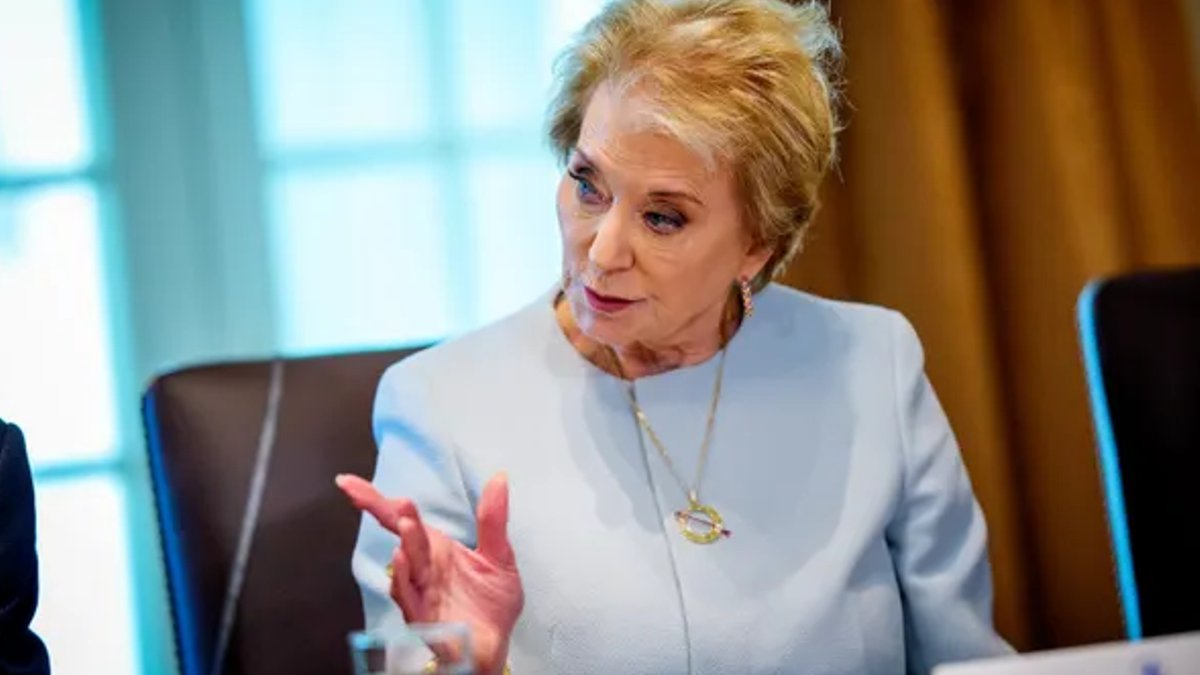
U.S. Education Secretary Linda McMahon is calling on college leaders to commit to major policy reforms by the end of the year, including adopting clear admissions criteria and hiring faculty with diverse perspectives.
McMahon made the request in a letter to college leaders, urging them to place statements on their websites detailing their commitments to policy changes.
Higher education’s public trust has hit record lows, with only 38% of surveyed adults saying they have high confidence in the sector, according to the secretary.
A recent poll from Lumina Foundation and Gallup found that confidence in higher education has declined, with Democrats driving the decline this year.
Close to a third of respondents with low confidence in the sector pointed to political agendas on campus and high college costs as reasons for their lack of trust.
McMahon’s letter is the result of months of meetings with college leaders, and it asks colleges to consider several questions when detailing their policy reforms, such as managing program costs and fighting grade inflation.
Among these questions are how colleges will contain costs and manage disruptive campus protests.
Jonathan Pidluzny, the U.S. Department of Education’s deputy chief of staff for policy and programs, said that the Education Department is quite thrilled and gratified to find leaders who believe the sector has an opportunity to change.
Pidluzny noted that colleges will not face direct penalties for not complying with McMahon’s call to action.
Silence will speak volumes if they refuse to engage in the effort, he added.
The Education Department’s call to action is a separate effort from the higher education compact pitched last year.
McMahon made the request in a Monday letter, urging colleges to place statements prominently on their websites detailing their commitments to those policy changes.
“Only full candor and transparency can begin to strengthen the bonds between higher education and the American people,” McMahon said.
According to the secretary, that trust has hit “record lows.”
Related: Massachusetts gets 23M for clean energy upgrades
Jonathan Pidluzny, the U.S. Department of Education’s deputy chief of staff for policy and programs, told Bloomberg, which first reported on the letter.
Pidluzny told Higher Ed Dive on Monday that the Education Department was “quite thrilled and gratified” to find leaders who believe the sector has an opportunity to change.
“There are a lot of reform-minded presidents out there who really do believe that it’s time for higher education to do a kind of U-turn, who wouldn’t dispute that these are serious problems that are really, really imperiling the entire sector and driving public confidence down,” Pidluzny said.
Pidluzny said colleges will not face “direct penalties” tied to McMahon’s call to action.
But, he added, “Universities that refuse to engage in this sort of good faith exercise to sort of recommit to delivering for American families, I think that silence will speak volumes, right?”
Although McMahon’s letter shares many of the same concerns pointed to in the higher education compact pitched last year, its approach varies.
Pidluzny described Monday’s letter as a “separate effort” from the compact.
The compact directed colleges to make firm policy commitments, such as requiring all undergraduate applicants to submit standardized test scores and freezing tuition rates for five years.
The new letter instead asks college leaders to answer several questions when detailing their policy reforms.
Among those, McMahon asks colleges to consider how they will manage disruptive campus protests, contain costs, fight grade inflation, meet workforce needs, approach artificial intelligence, encourage diversity of thought across programs and ensure programs aren’t exposed to foreign influence.
“This forthright conversation with the American people is long overdue. And it is the essential first step toward rebuilding trust in the sector,” McMahon wrote.
Pidluzny said the Education Department wanted to issue a call to action that would be relevant across different types of institutions.
“There are some institutions where merit-based admissions and merit-based hiring is an urgent problem that needs to be addressed,” he said.
